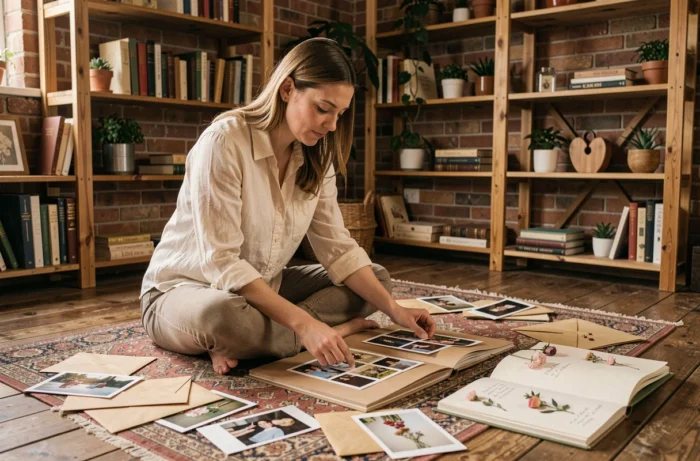
You have hundreds of family photos on your phone, organized by date, sometimes by folder. Yet, when you search for a specific shot from a birthday or a rainy Sunday, you scroll for long minutes. Creating a family photo album is about giving a narrative thread to these scattered images. Not just printing them: organizing them so they tell something true.
Transforming the family photo album into a documentary archive
Most albums stop at layout. You choose a format, slide in the photos, add a date. The result is pretty, but in twenty years, no one will know who the lady in the red sweater is in the Christmas 2019 photo.
Every photo deserves a caption that identifies the people, the place, and the context. This is the difference between a decorative object and a transferable document. Note the first names of the people, the exact location, and if possible, the reason for the gathering. This habit may seem tedious at first, but it gives the album a documentary value that your children will appreciate much later.
Specialized platforms like joliefamily.fr make this work easier by offering dedicated spaces for annotations and page customization. The idea is not to fill every inch with text, but to provide the markers that will allow someone else to understand the image without your help.
Also consider integrating physical elements when the format allows: a ticket, a folded invitation, a travel tag. These objects anchor the memory in reality, beyond the photo.
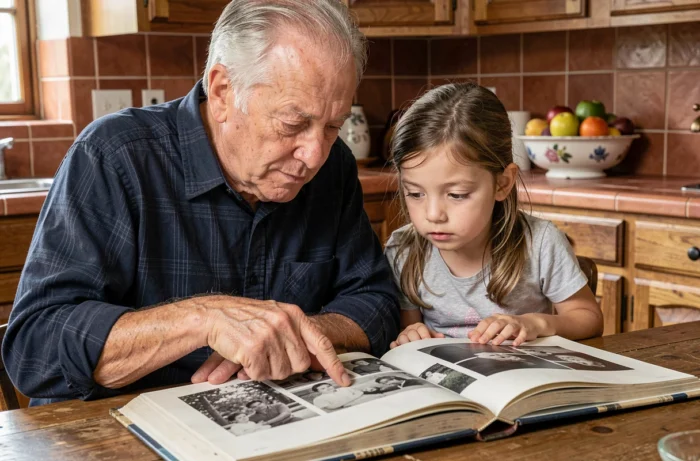
Photo album layout: choosing the narrative thread
Before touching the cover or format, ask yourself a simple question: what story do you want to tell? An album without a guiding thread resembles a gallery of random images. With a clear angle, each page gains coherence.
Organizing pages by emotion rather than by date
Chronological sorting is the natural reflex. It works for a birth or wedding album. For a family album that spans several years, it quickly becomes monotonous.
Grouping photos by mood creates a more vibrant narrative. A double page dedicated to laughter (from all eras) has more impact than a succession of months. You can also structure the album around recurring locations: the vacation home, the grandparents’ garden, the kitchen on a Sunday morning.
Varying the visual rhythm between pages
A common mistake is to fill each page with the same number of photos, the same framing, the same margin. The eye gets used to it and stops noticing.
Alternate between pages with a single full-page image and pages with several thumbnails. A strong photo deserves a whole page without distraction. Conversely, everyday moments (breakfast, walks, board games) benefit from being grouped in a mosaic to show the accumulation of small moments.
- A double page “portrait” with a single large format shot and a short caption, for significant photos
- A “mosaic” page of four to six smaller images, linked by a common theme (meals, walks, crafts)
- A “memory” page mixing photo, scanned handwritten text, and a small digitized object (child’s drawing, postcard)
Children’s right to image in a shared photo album
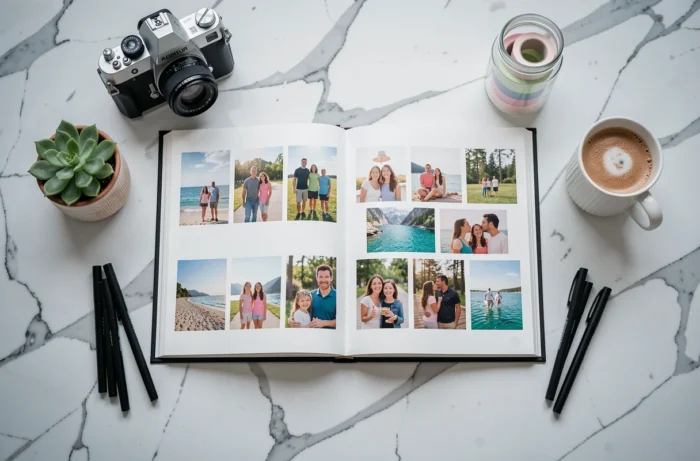
Creating an album also means deciding who will see it. And this question takes on a legal dimension as soon as minors appear in the photos.
Law No. 2024-120 of February 19, 2024, requires the joint exercise of the right to image of children by both parents. In practice, if you are separated, the other parent must give their consent before any distribution of a photo showing your child. This rule applies even for a digital album shared via a private link.
The law also provides that the child should be involved in the decision according to their age and maturity. A teenager can therefore refuse for a photo of them to appear in an album shared with the extended family. This is not a whim: it is a right.
For a physical album intended to stay at your home, the constraint is less. But as soon as you consider digital sharing or printing via an online service, check the conditions for hosting the images. Some services keep a copy of your files after the order.
Backing up photo files: the rule to know before printing
You have spent hours selecting and arranging your photos. The book is ordered, the album arrives at your home. Then your hard drive crashes, and you lose all the source files.
The 3-2-1 backup method protects your photos against this scenario: three copies of each file, on two different media (hard drive and USB stick, for example), with one copy stored in another physical location or on a cloud service.
This precaution also applies to the layout file of your album. If you want to reprint it in a few years or create an updated version, having the source project avoids starting over from scratch.
- Copy 1: the hard drive of your main computer
- Copy 2: an external medium (USB stick, portable hard drive)
- Copy 3: an online storage space or a drive kept at a relative’s

A family photo album does not need to be perfect to have value. Slightly blurry photos, awkward framing, cluttered backgrounds are part of the authenticity of the document. The biggest risk is not poor layout; it’s never starting. Take your twenty best photos of the year, add a few captions, choose a format you like, and get started. The album will grow richer over time.