
Converting 400 ml to centilitres involves dividing by 10, which gives 400 ml = 40 cl. The calculation is simple, but the real difficulty begins when handling multiple units in the same recipe or reading a graduated measuring cup in millilitres while the cookbook refers to centilitres.
This article details the mechanics of conversion, the reading pitfalls on common utensils, and the discrepancies caused by the density of an ingredient.
Conversion table from ml to cl for common kitchen volumes
Rather than memorizing a single equivalence, a reference table covering the most common volumes in recipes saves time. The rule is always the same: divide the number of millilitres by 10.
| Millilitres (ml) | Centilitres (cl) | Common usage |
|---|---|---|
| 5 ml | 0.5 cl | Teaspoon |
| 15 ml | 1.5 cl | Tablespoon |
| 100 ml | 10 cl | Small glass |
| 200 ml | 20 cl | Standard glass |
| 250 ml | 25 cl | Mug, measuring cup |
| 400 ml | 40 cl | Large bowl, carton of condensed milk |
| 500 ml | 50 cl | Bottle of tap water |
| 750 ml | 75 cl | Bottle of wine |
| 1,000 ml | 100 cl | 1 litre |
This table highlights a point that is often forgotten: the conversion of 400 ml to centilitres is just a specific case of an identical operation at all scales. Moving the decimal point one place to the left is sufficient each time.

Calculating ml to cl: why divide by 10 and not by 100
A recurring mistake is to confuse the conversion factor with that of the litre. The litre contains 1,000 ml or 100 cl. Therefore, to convert from millilitres to centilitres, we do not divide by 100 (which would be the conversion to litres), but rather by 10.
Origin of the factor 10
The prefix “milli” denotes a thousandth, while the prefix “centi” denotes a hundredth. The ratio between a thousandth and a hundredth is 10. It is this fixed ratio that makes the conversion purely mechanical, without rounding or approximation.
For the reverse conversion, from centilitres to millilitres, we multiply by 10. Thus, 40 cl gives back 400 ml.
Correct notation of symbols
The recommended notation is mL for millilitre and cL for centilitre, with an uppercase L. In common practice, “ml” and “cl” in lowercase are still widely used and understood, but on a medical measuring device or food packaging, the official spelling is with the uppercase L. One millilitre also exactly corresponds to one cubic centimetre (cm³), which may appear on some syringes or test tubes.
Volume and mass: the error caused by imprecise recipes
Many recipes indicate “400 ml of milk” or “400 ml of oil” without specifying whether it is a volume or a weight. For water, the confusion is inconsequential: 400 ml of water weighs approximately 400 g. However, for other liquid ingredients, the discrepancy is real.
Density and conversion: the measuring cup trap
The equivalence between grams and millilitres depends on the density of the ingredient. Oil, being less dense than water, weighs less for the same volume. Honey, being denser, weighs more. Using a graduated measuring cup in millilitres to measure “400 g of honey” produces an insufficient amount, as honey occupies less volume than water for the same weight.
- Water: the ml/g correspondence is almost direct, which simplifies calculations in baking when the recipe refers to grams.
- Oil: at equal volume, the weight is less than that of water. Measuring 400 ml of oil on a scale yields a result significantly below 400 g.
- Honey or syrup: at equal volume, the weight exceeds that of water. 400 ml of honey weighs significantly more than 400 g.
- Flour: often measured by volume in Anglo-Saxon recipes, its density varies depending on compaction. A measuring cup is only reliable if the flour is not packed down.
The lesson is straightforward: converting 400 ml to 40 cl remains accurate regardless of the ingredient (this is a volume-to-volume conversion). But converting 400 ml to grams without considering density introduces a dosage error.
Measuring utensils in the kitchen: reading graduations without error
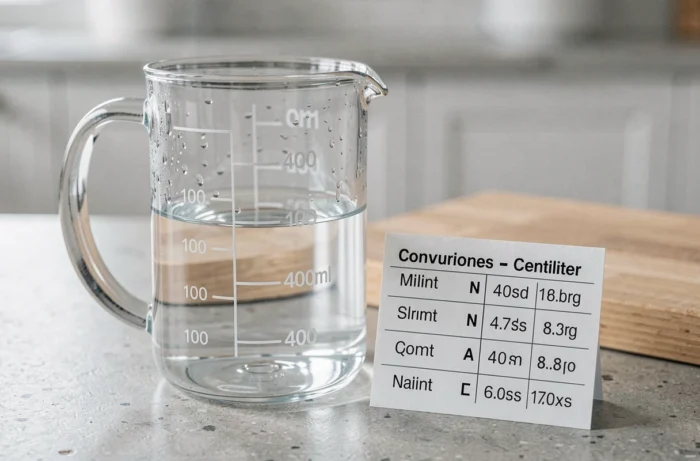
Measuring cups sold in France typically display graduations in millilitres on one side and in centilitres (or fractions of a litre) on the other. A standard tablespoon holds about 15 ml, or 1.5 cl. A teaspoon holds about 5 ml, or 0.5 cl.
Anglo-Saxon recipes and fluid ounces
When a recipe mentions fluid ounces, it is necessary to identify whether it is the American or British system, as their volumes are not identical. The conversion to centilitres cannot be deduced from a simple single factor without knowing the reference system. For 400 ml, the result in centilitres remains 40 cl, but the reverse (starting from fluid ounces to arrive at cl) requires specifying the country of origin of the recipe.
Medical measuring devices
The graduations in mL and cm³ represent the same volume on a syringe or a pharmaceutical measuring cup. Mentally transposing a prescribed medication dose in mL to a kitchen glass graduated in cl is not advisable: the margin of error of a kitchen glass exceeds that of a calibrated medical measuring device.
Reducing and converting: checking the actual capacity on the label
Since July 2024, certain consumer products affected by a decrease in quantity must have a specific display in stores, showing both the old and new capacities. Knowing how to quickly convert millilitres to centilitres allows for comparing two formats of the same product when one shows 400 ml and the other 37.5 cl, for example.
This conversion skill is particularly relevant in the beverage aisle, where capacities are sometimes expressed in ml on the bottle and in cl on the price label per litre.
The conversion of 400 ml to centilitres is a straightforward operation: divide by 10 to get 40 cl. The real difficulty lies not in the calculation, but in reading the utensils, distinguishing between volume and mass, and being vigilant regarding Anglo-Saxon units. Keeping the factor of 10 in mind covers all conversions between millilitres and centilitres, regardless of the context.