
The size of a pool is not chosen from a catalog. It results from a trade-off between available land area, local regulatory constraints, and usage program. We regularly observe that projects sized “to standard” generate avoidable compromises on peripheral circulation or landscape coherence. It is better to reason in terms of net usable area rather than displayed length.
Regulatory setbacks and actual footprint: what the local urban plan changes about pool size
Too many projects start from a desired size without checking the actual margin of maneuver on the plot. The setback between the pool and the property line is not set by a single national rule. It is the local urban plan that imposes the distance, which varies by zone: some urban planning documents prescribe a setback of one meter, others three meters, and some areas impose no specific setback.
This local variability directly modifies the buildable area. On a plot of modest width, a setback of three meters on each side reduces the usable width by six meters. A rectangular pool four meters wide then becomes impossible without a variance.
We recommend consulting the local urban planning department before any feasibility study. To determine the ideal pool size, one must start from the net area available after applying setbacks, not from the total garden area.
Another often overlooked point: the presence of a shelter or cover. A covering device exceeding 1.80 m in height can shift the project from a simple prior declaration to a building permit, even if the surface area of the pool remains below the regulatory threshold. This parameter influences the overall sizing, as it conditions the type of protection that can be considered.
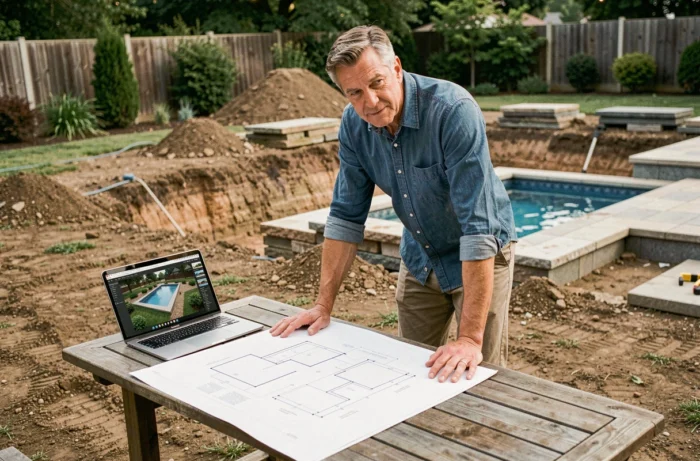
Pool-garden ratio and peripheral circulation: sizing without suffocating the outdoors
A pool that is too large for the plot does not enhance the outdoors; it overwhelms it. We observe that a ratio where the pool occupies more than a third of the vegetated area creates a visual imbalance that is difficult to correct through landscaping alone.
The peripheral beach as an adjustment variable
The circulation around the pool conditions the comfort of use and safety. A minimum beach of one meter on three sides and one meter fifty on the main access side constitutes a professional standard. These margins must be integrated into the footprint calculation from the start.
Let’s take a plot where the usable area (after PLU setbacks) measures ten meters by seven. A peripheral beach of one meter fifty on the long side and one meter on the other three reduces the pool envelope to about seven meters by five. The maximum size of the pool results from subtracting the margins, not the other way around.
Pool shape and perception of space
A rectangular pool produces clear lines that structure the space but accentuate the feeling of ground occupation. In a narrow garden, a free-form or rounded corner pool reduces this impression without losing swimming area.
The choice between a polyester shell and custom masonry construction comes into play here: shells impose catalog dimensions, while masonry allows for adjustments to each dimension by the centimeter. On an atypical plot (trapezoidal, sloped, with a blind angle), the custom solution avoids sacrificing usable area.
Usage program and depth: calibrating the pool to its actual function
A relaxation pool and a swimming lane do not have the same proportions or depth. Defining the primary use before setting the dimensions avoids compromises that satisfy no one.
- Relaxation and family play: a compact pool with a gradual depth ranging from a shallow flat bottom to an intermediate area is sufficient. Width takes precedence over length to allow lateral movements.
- Competitive swimming: a swimming lane requires a significant minimum length and a reduced width. The depth must remain constant along the entire length for consistent swimming comfort.
- Mixed use (swimming and bathing): a rectangular pool with a shallow area at one end and a deeper pit at the other offers the best compromise, provided the total length allows for some continuous swimming movements.
Depth also influences water volume, thus affecting treatment and heating costs. A shallower pool over most of its surface reduces the total volume without penalizing swimming comfort for family use.
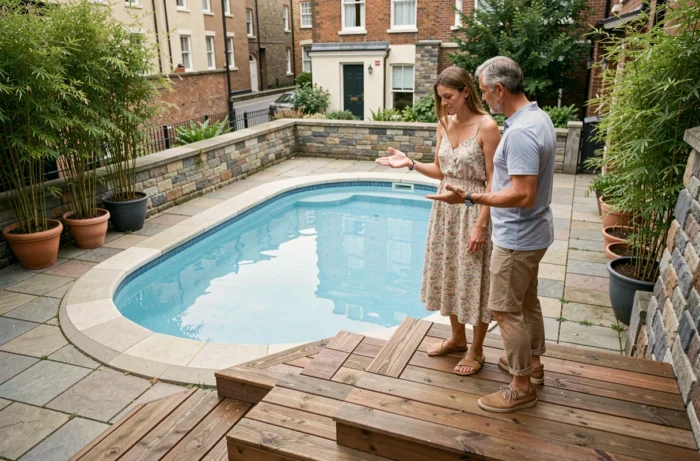
Landscape integration and enhancement of the outdoors: beyond square meters
The ideal size is not only functional. A well-proportioned pool in relation to its environment increases the visual coherence of the entire garden. We favor an approach where the pool interacts with existing elements: terrace, vegetation, fences, buildings.
An inground pool whose coping extends the level of the terrace creates a continuity of materials that visually enlarges the space. Conversely, a pool placed without transition in the middle of a lawn fragments the garden into disconnected zones.
The design of the pool also contributes to this integration. The colors of the liner or shell, the choice of coping (natural stone, composite wood, exposed aggregate concrete), and the orientation concerning sunlight are parameters that should be decided at the same time as the dimensions, not afterward.
- Orienting the length of the pool along the main view from the house enhances perspective.
- Aligning the coping with the terrace level eliminates the visual break between dry space and aquatic space.
- Planning a planted area between the pool and the fence mitigates the effect of “pool placed on the ground.”
Pool sizing is an exercise in synthesis between cadastral constraints, local urban planning rules, functional program, and landscape ambition. A pool slightly smaller than the maximum possible allows for breathing room in the garden and facilitates the layout of the surroundings. It is often this slight retreat that makes the difference between a simply equipped outdoor space and one that is truly enhanced.