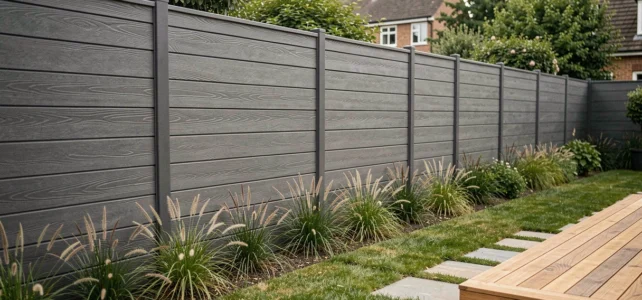
Comparing fencing materials often comes down to balancing three variables: lifespan, long-term maintenance costs, and visual appeal after several years of exposure. Composite fencing, a blend of wood fibers and polymers, positions itself on these three axes against natural wood, PVC, and aluminum. The next step is to measure the actual differences between these options to determine which one lives up to its promises over time.
Composite vs. Wood, PVC, and Aluminum: Performance Comparison
The choice of garden fencing material depends on measurable criteria. The table below summarizes the differences observed in the main decision-making factors.
| Criterion | Natural Wood | PVC | Composite (WPC) | Aluminum |
|---|---|---|---|---|
| Moisture Resistance | Low (risk of rotting) | Good | Very good | Very good |
| UV Resistance | Medium (graying) | Medium (yellowing) | Good (co-extruded boards) | Good (powder coating) |
| Regular Maintenance | Stain or paint every 2-3 years | Water cleaning | Water cleaning | Water cleaning |
| Scratch Risk | Medium | Low | Medium to high | Low |
| Customization (colors, textures) | Limited (wood tones) | Limited | Wide (wood imitation, anthracite, teak) | Wide (RAL) |
| Recyclability at End of Life | Yes (biodegradable) | Partial | Yes (recycled and recyclable materials) | Yes |
Natural wood remains the most maintenance-intensive material. PVC performs well against moisture but does not withstand prolonged UV exposure, leading to visible yellowing after a few seasons. Aluminum offers excellent technical performance but at a significantly higher cost.
Composite stands out for its balance between durability and low maintenance. To choose a composite garden fence suitable for your project, it is essential to understand what differentiates mono-extruded ranges from co-extruded ranges, as the durability gaps are significant.
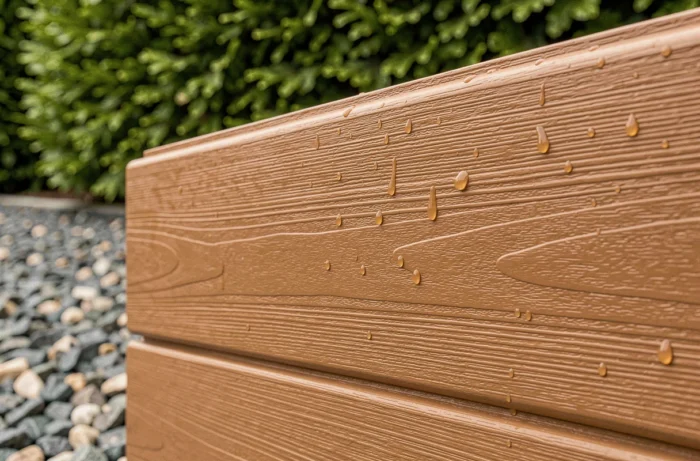
Co-extruded and Mono-extruded Boards: A Real Durability Gap
Not all composite fences are created equal. The manufacturing technique directly affects longevity.
Mono-extruded boards are made from a single homogeneous layer. They offer a good price-quality ratio at purchase, but their surface is more susceptible to stains, scratches, and slight discoloration over the long term.
Co-extruded boards benefit from a 360-degree protective shield applied around the composite core. This outer layer makes the board more resistant to damage: moisture, UV, insects. The difference is particularly noticeable after several years of exposure when mono-extruded boards begin to show signs of wear that co-extruded boards do not.
This process explains why some manufacturers offer warranties ranging from 10 to 25 years depending on the ranges. These warranties generally cover structural and manufacturing defects, not just product compliance. Checking the exact scope of the warranty before purchase is a useful reflex, as conditions vary from one manufacturer to another.
Composite Maintenance: What the Field Confirms
The “zero maintenance” argument deserves a nuance. Composite does not require staining, painting, or fungicidal treatment. A cleaning with clear water or low-pressure washing once or twice a year is sufficient to maintain its original appearance. In comparison, a wooden fence requires sanding and regular staining to prevent graying.
Composite does not rot and does not warp due to moisture, making it particularly suitable for rainy regions or gardens near a water source.
However, composite does have a sensitivity to scratches that should not be overlooked. The friction from gardening tools, contact with metal objects, or repeated impacts can leave visible marks, especially on darker shades like anthracite. This flaw is more pronounced in entry-level ranges.
Concrete Points of Caution
- Avoid using a pressure washer at close range, as it can damage the surface layer of co-extruded boards
- Quickly treat grease or tannin stains (from dead leaves), as they can become ingrained if left for several weeks
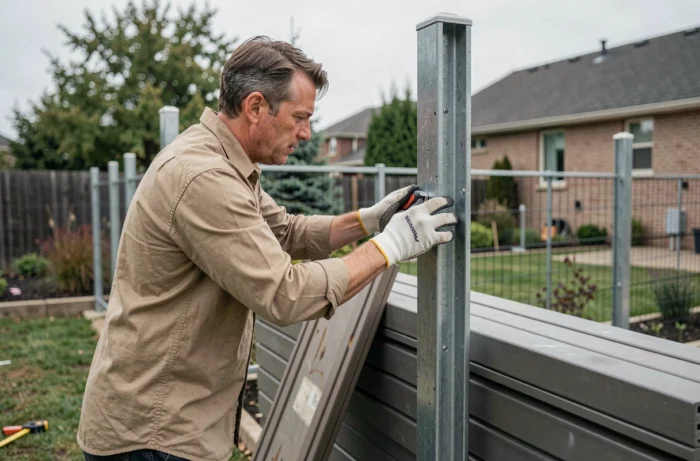
- Ensure that the fixing posts are made of aluminum and properly sealed, as the stability of the whole structure depends as much on the posts as on the boards
Composite Fencing and Environmental Impact: Recycled Materials and End of Life
WPC (Wood Plastic Composite) is made from a blend of wood fibers and recycled plastics. This composition reduces the consumption of virgin wood compared to solid wood fencing. Several manufacturers are now highlighting the recyclability of the product at the end of its life, positioning composite within a circular economy logic.
This point differentiates composite from traditional PVC, which has partial recyclability and depends on local processing channels. Natural wood remains biodegradable but involves chemical treatment (autoclave, stain) whose residues raise questions at the end of the cycle.
Composite offers a compromise between technical performance and controlled environmental footprint. For projects where ecological durability is as important as mechanical longevity, this material presents a documented advantage.
Design and Landscape Integration: Available Colors, Textures, and Styles
Composite faithfully replicates the appearance of wood without suffering from its constraints. Current ranges offer veined textures, smooth or brushed finishes, and a color palette ranging from light teak to anthracite gray.
This variety allows the fence to be adapted to the style of the exterior:
- Wood tones (teak, oak) for a natural look in harmony with a landscaped garden
- Anthracite or dark gray for a contemporary style, often paired with aluminum posts
- Mixed finishes (composite boards and aluminum inserts) for a clean and structured design
The anthracite color remains the most requested in composite fence configurations, according to the catalogs of major distributors. It pairs well with modern joinery and light facades.
The stability of colors over time directly depends on the manufacturing process. Co-extruded boards retain their color longer than mono-extruded ones, justifying the price difference at purchase for a project designed for longevity.
The composite material does not require choosing between aesthetics and durability. The technical data, manufacturer warranties, and low maintenance cost over the complete life cycle make it a measurable and documented option compared to traditional alternatives.