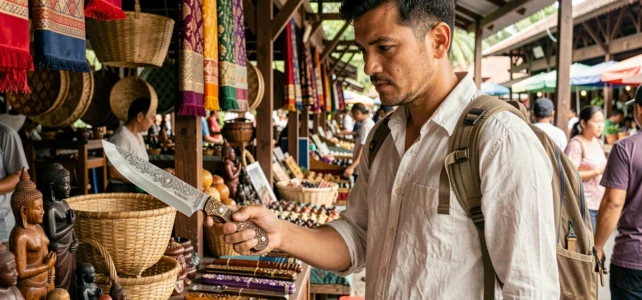
Thailand attracts millions of travelers every year, and among the practical questions that arise before departure, the issue of transporting knives remains poorly documented. Between Thai legal frameworks, aviation security rules, and new checked baggage screening procedures, there are many gray areas. Here’s what you need to know before slipping a pocket knife or an Opinel into your bag.
New checked baggage screening rules at Thai airports
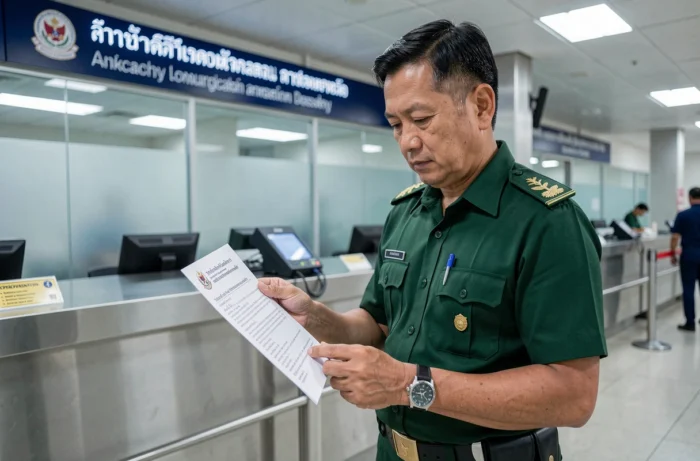
A major change comes into effect from October 16, 2026: the Civil Aviation Authority of Thailand (CAAT) now allows airport security agents to open checked baggage without the passenger present. This measure applies whenever an item is deemed “prohibited, dangerous, or suspicious” during X-ray screening.
In practice, if you are transporting a knife in checked baggage, it will be detected by imaging. The entire opening and searching procedure must be recorded on video by the agents, and a written inspection notice is placed in the luggage to inform the traveler.
The critical point for knife enthusiasts: items considered prohibited can be confiscated without restitution or compensation. The distinction between a kitchen knife bought as a souvenir and a dangerous weapon is based on the agent’s assessment at the time of inspection. Field reports vary on this point, as the evaluation criteria are not publicly detailed.
To better understand the legislation on knives in Thailand, it is useful to distinguish between what falls under Thai law regarding the carrying of bladed weapons and what falls under aviation security rules, as the two frameworks overlap without always coinciding.
Carrying a knife in Thailand: what local law regulates
Thailand does not have a single law dedicated to knives. The legal framework is based on several texts, including the Criminal Code and the Weapons Act. Carrying a bladed weapon in a public place without a legitimate reason constitutes an offense. The difficulty lies in defining “legitimate reason,” which is not precisely codified.
A folding pocket knife with a short blade, used as a daily tool, is practically tolerated in most situations. In contrast, a fixed-blade knife such as a hunting or bushcraft knife, carried in an urban backpack, may be perceived very differently by local police.
Travel forums report contradictory experiences. Some backpackers travel through Thailand for weeks with a multi-tool knife without encountering problems. Others have their knife confiscated during a routine check, especially near temples, royal palaces, or during public events where security is heightened.
Sensitive areas and local context
Tolerance varies by province. The tourist areas of Bangkok, Phuket, or Chiang Mai have security forces accustomed to tourists and their hiking gear. The available data does not allow for a conclusion of uniform enforcement across the territory.
The southern border provinces, where a state of emergency is sometimes in effect, apply significantly stricter controls. Transporting a knife in these regions exposes you to increased risks of being stopped.
Knife in cabin baggage or checked baggage: aviation security rules
The distinction between cabin and checked baggage remains the central point for any traveler. The international rules from ICAO, adopted by airlines operating to and from Thailand, are unequivocal on one point: any knife with a blade longer than 6 cm is prohibited in the cabin.
For blades shorter than 6 cm, the situation depends on the airline and the airport. Some Thai airlines enforce a zero-tolerance policy and refuse any sharp object in the cabin, regardless of blade size. Others adhere to the 6 cm limit.
- In the cabin: no fixed-blade knives, no folding knives with blades exceeding 6 cm. Round-tipped knives (like butter knives) are generally accepted
- In checked baggage: knives are allowed, provided they are properly packaged (hard case, blade protected) to avoid injuring handling staff
- Upon arrival in Thailand: customs declaration is not required for an ordinary pocket knife, but a large or military-style knife may trigger additional inspection
TSA locks: a precaution that has become almost mandatory
With the new CAAT procedures, agents can destroy a non-TSA compatible lock to access the contents of a suspicious bag. If your suitcase contains a knife in checked baggage and is secured with a standard lock, you risk finding your bag forced open and your knife confiscated.
Using a TSA-compatible lock allows agents to open the bag with a universal key, conduct the inspection, and then re-lock the suitcase. This is the only way to limit material damage while complying with the new rules.

Bringing a Thai knife back to France: declaration and customs
Thailand produces handcrafted knives sought after by collectors, especially in the northern regions. The question of returning to France with such a purchase deserves to be addressed separately, as French regulations apply upon arrival.
In France, knives are classified as category D bladed weapons. Their transport is regulated: you must have a legitimate reason (returning from purchase, moving to a place of practice). The knife must travel in checked baggage, in its packaging, separated from any immediate access.
- A small folding pocket knife generally poses no problem at French customs
- A large fixed-blade knife may be subject to verification, especially if transported without commercial packaging
- Military-style knives or machetes are likely to be seized if the reason for transport is deemed unacceptable
Passing through Thailand does not change the obligations upon arrival on French soil. The purchase invoice, kept with the knife in checked baggage, serves as the simplest proof in case of customs inspection.
The overlap of Thai, aviation, and French regulations makes the subject more complex than it seems. Each step of the journey (carrying on-site, boarding, arrival) falls under a distinct legal framework. Checking the applicable rules at each link in the chain remains the only reliable approach to avoid confiscation or penalties.