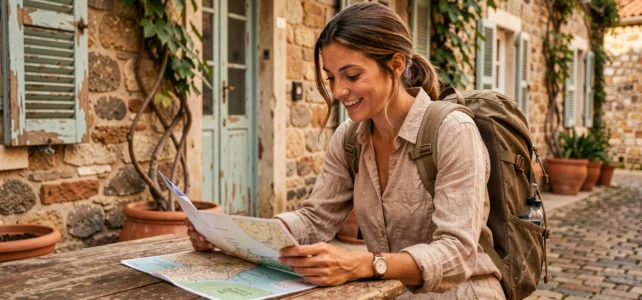
Rethinking the pace, transportation, and relationship to the places traversed: this is the guiding thread of slow travel and solo travel, which since 2025 has shifted from a niche status to a mainstream trend in Europe. A growing desire for depth rather than accumulation guides these new ways of traveling.
Digital detox while traveling: disconnect to see better
Have you ever noticed that some vacation memories are reduced to photos on a phone? The JOMO (Joy Of Missing Out) profile counters this habit. It involves choosing to disconnect voluntarily during a stay, not due to technical constraints, but by personal decision.
This movement goes beyond simply putting down your smartphone. Accommodations in Europe now offer stays without Wi-Fi or network coverage, in isolated cabins or mountain lodges. The principle is simple: without screens, attention shifts to the immediate environment, conversations, and sounds.
The DERTOUR 2026 report on European travel trends identifies digital detox as a central driver of alternative travel. It is no longer a curiosity: it is a criterion for choosing accommodation for a growing number of travelers. Those who wish to explore the site Tout Mon Monde will find concrete ideas for organizing this type of stay.
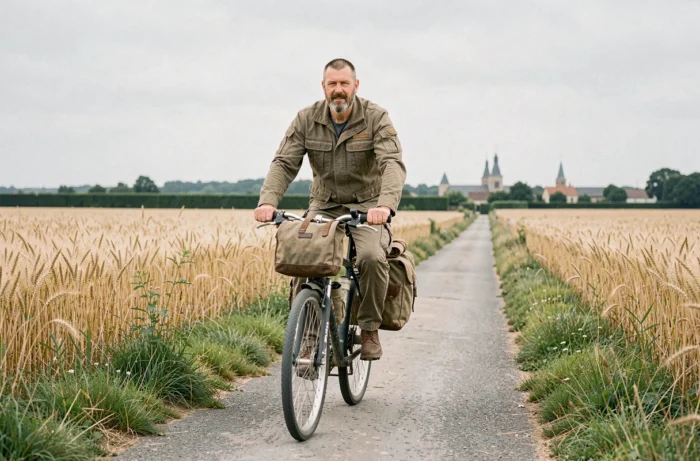
Slow travel by train: the journey as a destination
Taking the night train between Paris and Vienna, crossing Portugal by regional train, following the Norwegian coast by coastal express: in each of these cases, the journey becomes an integral part of the experience. Slow travel by train is based on a clear educational principle: slowing down allows for the observation of what speed erases.
In practical terms, traveling by train rather than by plane over short and medium distances changes the perception of the territory. You see the landscapes change gradually. You pass through train stations in small towns where no one gets off. You eat in a dining car instead of an airport terminal.
Why trains attract beyond the ecological argument
The environmental aspect is often highlighted, rightly so. The European regulation ReFuelEU Aviation, which came into effect to push the aviation sector towards sustainable fuels, reminds us that flying remains a mode of transport under increasing regulatory pressure.
The appeal of trains goes beyond this argument. The comfort of slow travel reduces travel-related fatigue. No security checks, no boarding lines, no airport-city transfers. Travel time transforms into time for rest or reading.
Walking holidays: walking as a mode of discovery
Euronews reported in August 2026 that walking holidays are seen as an antidote to overtourism that Europe needs. The idea is not new, but its large-scale application is more so.
Walking to travel imposes a natural filter. You cannot visit five cities in three days on foot. This physical constraint forces you to select a limited territory and explore it in depth. A village, a valley, a coastline.
What walking changes in the relationship to place
By bike or car, the landscape rushes by. On foot, it settles in. The average speed of a walker (four to five kilometers per hour) allows time to notice details: a facade, a side path, a cooking smell. It is a mode of travel that prioritizes nature and spontaneous encounters.
The long-distance hiking trails in France (GR) offer a dense and marked network. But this approach works everywhere: following the coast of the Cinque Terre in Italy, crossing the Scottish Highlands, or traversing rural paths in Japan.
- Choosing an itinerary of three to seven days allows for immersion without exhaustion, with a light backpack and short stages
- Prioritizing accommodations with locals or in lodges transforms each evening into a local encounter
- Traveling off-peak (autumn or spring) ensures quiet trails and reduced accommodation rates, as highlighted by an Expedia analysis on savings achievable by traveling in autumn

Solo travel in Europe: a common practice
The DERTOUR 2026 report indicates that a significant portion of Europeans are considering traveling alone in the next twelve months. This observation reflects a structural change, not a passing trend. Solo travel was long associated with a specific profile (young backpacker, retiree). Today, it concerns all age groups and budgets.
Traveling alone does not mean traveling in isolation. Next-generation hostels, open hiking groups, and guest tables create spaces for socialization without obligation. Solo travel allows you to set your own pace: getting up early for a market, spending an entire day in a museum, changing your itinerary without negotiation.
Accessible destinations for a first solo trip
France remains the simplest choice to start. An article from Figaro mentioned in August 2026 European destinations less than three hours from Paris with affordable hotel nights, such as Bulgaria. Portugal, Slovenia, and the Baltic countries also offer an excellent balance of safety, cost, and change of scenery.
- The language barrier is almost non-existent in European capitals, making it easier for a first solo departure
- Offline mapping apps and collaborative guides now replace agencies to organize a personalized itinerary
- Testing a long weekend solo before a two-week trip allows you to confirm that this format suits your temperament
Solidarity tourism, wwoofing, or stays in eco-villages complement this palette for those seeking a dimension of commitment in their adventure. Each of these formulas shares a common point: they reposition the traveler as an actor in their experience, not as a spectator of a preformatted tour.