
French recommendations on early childhood have significantly evolved in recent months. Between the tightening regulations on screens, new data on the impact of environmental noise, and adjustments to the health booklet, supporting a child’s awakening and well-being on a daily basis now relies on more precise guidelines than a few years ago. This article reviews the current frameworks and the concrete levers that truly matter.
Screens before 3 years: a regulatory ban in childcare settings
Most parenting guides recommend “limiting screens.” The regulatory reality now goes further. Since a decree of June 27, 2025, exposure of children under 3 years old to screens is formally prohibited in all early childhood care structures: nurseries, micro-nurseries, and childminders.
This ban covers all types of screens (television, smartphone, tablet, computer) and even applies to simple background noise. It replaces the previous, more flexible wording that merely advised against exposure.
Meanwhile, since January 2025, the health booklet given at birth explicitly includes the guideline “no screens before 3 years, including background noise.” For parents, this means that the official framework has fundamentally changed: it has shifted from a recommendation to an obligation in childcare settings, and from a vague piece of advice to a clearly stated guideline in the child’s medical follow-up document.
In practice, at home, no sanctions apply. However, families looking for reliable resources on supporting their child can consult the site mamanserepose.fr for children, which addresses these topics with updated guidelines. The tightening of regulations in collective structures sends a clear signal: health authorities consider that total absence of screens before 3 years is no longer an option among others, but the reference standard.

Road noise and children’s emotional development: what recent research shows
A rarely mentioned factor in advice on children’s well-being is environmental noise. An epidemiological study has highlighted that high and persistent exposure to road noise in early childhood is associated with an increased risk of emotional and relational difficulties by the age of 10.
This finding changes the game for parents living in dense urban areas or near busy roads. Field feedback on this point varies: some early childhood professionals downplay the impact by reminding that other factors (sleep, diet, interactions) weigh more heavily, while epidemiological data point to a significant statistical link.
Reducing daily noise exposure
Without moving, some practical adjustments can limit exposure:
- Place the child’s room on the courtyard side rather than the street side, prioritizing the room farthest from the source of road noise
- Close windows during peak traffic times (morning and late afternoon), even in summer, even if it means airing out at other times
- Use thick curtains or window seals to mitigate noise disturbances, especially during sleep phases
These measures do not eliminate the problem, but they reduce the cumulative exposure time, which seems to be the determining factor according to available data.
Daily routine and sleep: the guidelines that structure awakening
Sleep remains the foundation of development and learning in children. Current recommendations emphasize less on a single duration and more on the regularity of bedtime and wake-up times. A child who goes to bed at the same time every night, including weekends, generally exhibits fewer behavioral difficulties and better attention capacity during the day.
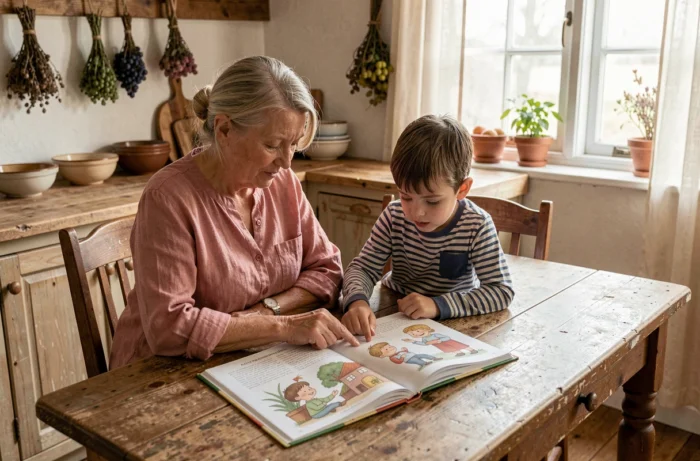
The evening routine does not need to be complex. Three elements are sufficient: a transition signal (tidying up toys, dimming the lights), a shared calm moment (reading, singing), and then the bedtime itself. What matters is the predictability of the sequence, not its duration.
Awakening activities during the day: prioritize depth
Multiplying activities does not necessarily provide more stimulation. A child who spends twenty minutes manipulating play dough, testing shapes, and observing textures develops more fine motor skills and concentration than a child who rushes through five different activities in an hour.
Prolonged exploration of the same material or game fosters deep learning. Parents who allow their child to return to the same activity multiple times, without seeking to vary for the sake of variety, often observe clearer progress in coordination and problem-solving.
The role of the adult during these awakening moments is mainly to observe before intervening. Describing what the child is doing (“you are stacking the red blocks”) rather than directing (“put the red on the blue”) enhances their autonomy and confidence in their own abilities.
Parental stress and child well-being: a direct link
The available data on child development converge on a often underestimated point: the level of stress in parents directly influences the behavior and well-being of the child. An exhausted or anxious parent inadvertently transmits this tension, even without open conflict.
This does not mean that one must achieve a state of permanent serenity, which would be unrealistic. However, identifying the times of day when family stress is highest (mornings before school, after work, bedtime) allows for targeted adjustments.
- Prepare the night before what creates pressure in the morning (clothes, backpack, breakfast)
- Establish a decompression period of a few minutes upon returning home, before starting the evening routine
- Accept that some evenings, the routine will be shortened, and that this does not compromise the child’s development
Regularity matters more than perfection. A generally stable framework, with occasional adjustments, provides the emotional security the child needs to explore and learn.
Supporting awakening does not rely on accumulating methods or activities, but on a few fundamentals applied consistently: a calm environment, predictable routines, and attention to the quality of interactions rather than their quantity.