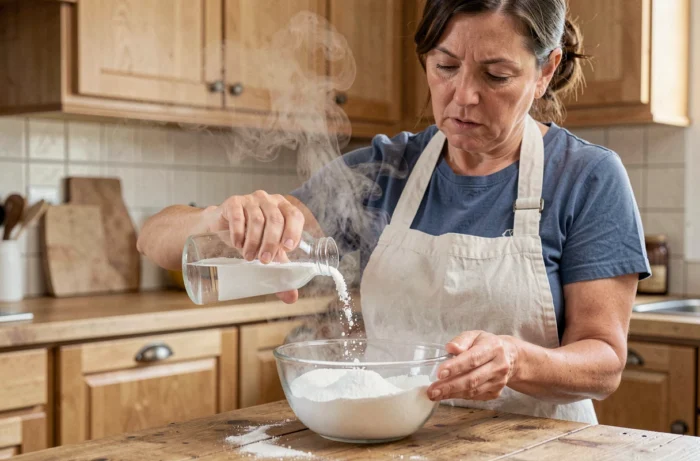
Mixing baking soda and vinegar creates a spectacular reaction, but what escapes from the container is not smoke. Recent educational resources emphasize this distinction: the visible cloud is a mixture of foam, carbon dioxide gas, and water droplets, not solid particles from combustion. Understanding this difference allows for better control of the visual effect and results in a denser, longer-lasting, and more impressive outcome using everyday ingredients.
Smoke, foam, or carbon dioxide: what baking soda really produces
Confusion is common. In chemistry, smoke refers to solid or liquid particles suspended in the air, usually resulting from combustion. The baking soda-vinegar mixture does not burn anything: it releases carbon dioxide (CO₂), a colorless and odorless gas.
The visual effect arises from the overflowing foam, sometimes accompanied by a slight mist when micro-droplets of water and vinegar are carried away by the gas release. Several updated educational sheets between 2024 and 2026 explicitly frame these experiments as demonstrations of gas production, not smoke.
This reframing has a direct practical interest. By trying to imitate smoke rather than increasing the release of CO₂ and foam, one misses the levers that make the effect truly spectacular. To consult Ceze for producing smoke, one must first accept that they are working with a gas and foam, and adapt their method accordingly.
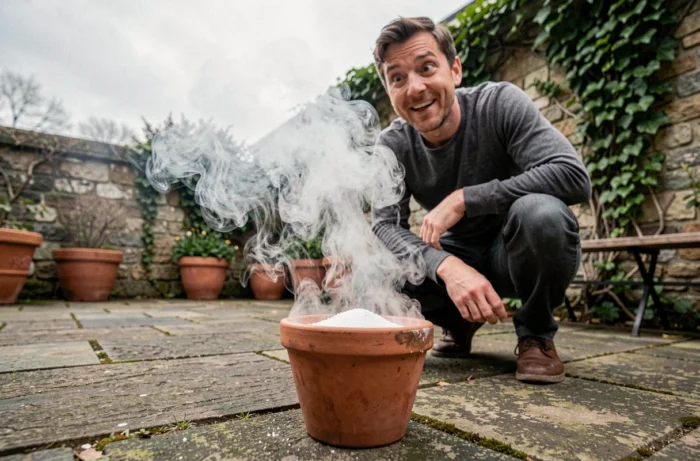
Baking soda and vinegar: a comparison of methods for maximum visual effect
Several variants circulate online. Their visual effectiveness depends on three parameters: the volume of foam, the speed of gas release, and the confinement of the mixture. Here’s how the main approaches compare.
| Method | Ingredients | Type of effect | Duration of effect | Difficulty |
|---|---|---|---|---|
| Open bottle | Baking soda + white vinegar | Overflowing foam | Several seconds | Very easy |
| Bottle + balloon | Baking soda + vinegar + balloon | Balloon inflating (captured CO₂) | Moderate | Easy |
| Bottle + dish soap | Baking soda + vinegar + liquid soap | Dense and voluminous foam | Longer | Easy |
| Narrow container + dye | Baking soda + vinegar + food coloring | Colored foam like a volcano | Several seconds | Easy |
| Warm mixture | Baking soda + warmed vinegar | Accelerated reaction, more visible mist | Very short | Easy |
The method with dish soap stands out clearly. The soap traps the CO₂ in bubbles that form a thick and persistent foam, visually creating an effect much closer to smoke than a simple liquid overflow.
Why dish soap changes everything
Without soap, the CO₂ escapes in a fraction of a second. The gas bubbles burst at the surface, and the effect drops immediately. Dish soap acts as a surfactant: it retains the gas in stable bubbles that accumulate into foam.
The result is a column of foam that rises, overflows, and spreads slowly, which much better mimics the appearance of thick smoke. Adding food coloring enhances the visual illusion.
Parameters that influence foam density with baking soda
Achieving a nice effect does not solely depend on the ingredients. The container, temperature, and proportions play a measurable role.
- The baking soda/vinegar ratio: too much vinegar drowns the reaction in excess liquid. Too much baking soda leaves undissolved powder at the bottom. A good starting point is to use about one tablespoon of baking soda for a glass of white vinegar, then adjust according to the container.
- The temperature of the vinegar: slightly warmed vinegar accelerates the chemical reaction and produces a faster release of CO₂, resulting in more explosive foam. However, the effect lasts less long.
- The shape of the container: a narrow neck (bottle, test tube, slender vase) concentrates the foam and forces it to rise high before overflowing, amplifying the impression of smoke escaping. A wide container produces a less spectacular horizontal spread.
- The amount of dish soap: a few drops are sufficient. An excess makes the foam too soapy and decreases the rising speed.
These parameters interact. A narrow neck combined with warm vinegar and soap produces the most impressive effect in terms of height and density.
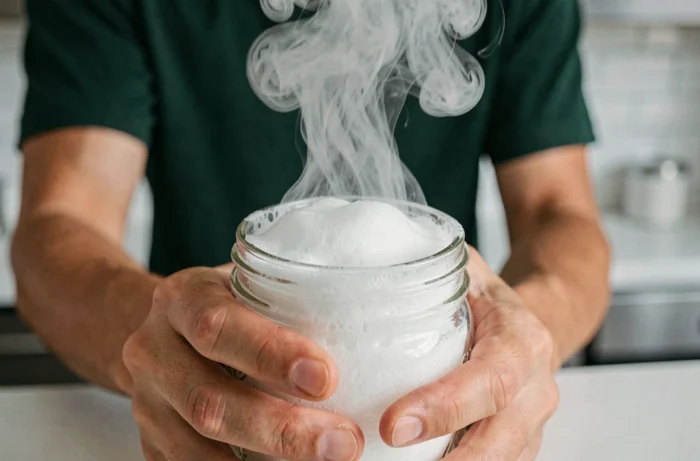
Safety and precautions for experiments with baking soda and vinegar
Baking soda and white vinegar are common food products, making this experiment suitable for children under supervision. The precautions remain simple but should be respected.
First rule: never seal the container airtight. The released CO₂ creates pressure that can cause a closed container to explode. Educational resources consistently recommend trays, open containers, and unsealed vessels to avoid overpressure.
Vinegar can irritate the eyes if splashed. Wearing safety goggles is a good habit, especially with children. Conducting the experiment on a tray or in a sink makes cleanup easier and prevents damage to surfaces.
What this experiment does not do
This reaction does not produce significant heat, flames, or toxic particles. It does not replace a smoke bomb (which relies on the combustion of chemical compounds like potassium nitrate mixed with sugar). Baking soda creates a foam and mist effect, not real smoke.
For decorative use (party, amateur filming, scientific experiment at home), the combination of baking soda, vinegar, and soap offers a visually satisfying result without any of the risks associated with combustion. The difference lies in the duration: a chemical smoke bomb produces smoke for several minutes, while the baking soda foam collapses in just a few tens of seconds at most, even with the best proportions.