
The “3+” marking on packaging only indicates a regulatory safety threshold, not the educational relevance of the toy. Choosing educational toys suitable for each age requires cross-referencing the child’s motor and cognitive development stage with the exact nature of the stimulation offered by the object.
We regularly observe purchases guided by the age range printed on the box, while two children of the same age may exhibit very different motor and language skills.
Digital passport and regulatory traceability of educational toys
The new European regulation on toy safety introduces a tool that most parental guides overlook: the product digital passport. Every toy placed on the market must carry an identifier that provides access to compliance information, warnings, and complete traceability of the manufacturing chain.
For parents, this passport becomes a concrete verification criterion that goes beyond the simple CE marking. It allows them to know if the toy complies with current chemical standards (restrictions on phthalates, flame retardants) and to verify that the manufacturer is identifiable.
Toys containing batteries or a rechargeable battery are subject to additional obligations: information on composition, capacity, lifespan, and collection methods. Sellers must be able to justify battery compliance starting August 2025. An online catalog that lists educational toys by age range while providing these compliance data facilitates sorting, as https://kidits.fr/ does on its product sheets.
Connected toys for children: cybersecurity and data collection
An educational robot that records voice, a learning tablet connected to Wi-Fi, an interactive animal controlled by an app: these objects pose a problem that their packaging almost never mentions. The upcoming European framework provides for enhanced cybersecurity and privacy protection requirements for connected toys.
We recommend checking three points before purchasing a connected toy:
- The ability to physically disable the microphone or network connection, not just via the app
- The parental permissions required for collecting the child’s voice or behavioral data
- The existence of documented software updates from the manufacturer, with an announced support duration
A connected educational toy intended for a four-year-old that collects data without granular parental control is not suitable, regardless of the quality of its educational content. Technical compliance determines educational relevance.
Development stage and type of stimulation: beyond age ranges
Voluntary grasping appears around six months, independent walking between ten and eighteen months, symbolic play around two years. These developmental milestones matter more than chronological age when choosing an educational toy.
Fine motor skills and problem-solving
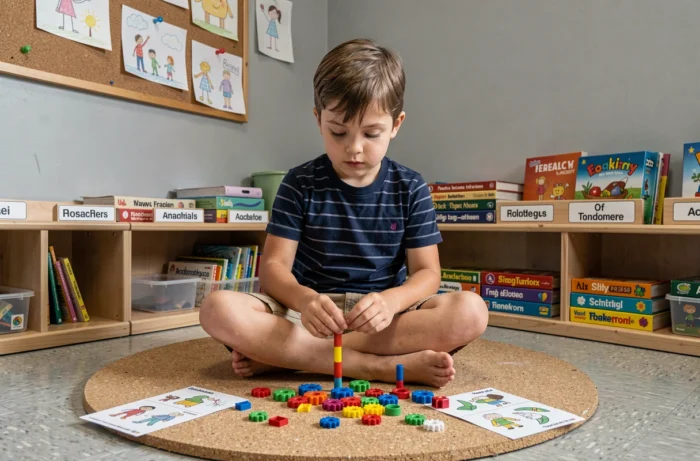
Stacking games, large-piece puzzles, and building blocks engage hand-eye coordination and spatial reasoning. A child who starts stacking (around twelve months) benefits more from simple cubes than from a construction game with a clip system designed for three years and older.
Direct observation remains the best indicator. If the child systematically diverts the toy from its intended use (using puzzle pieces as characters, for example), it signals that the object does not meet their current cognitive need.
Language and symbolic play
Cardboard books with textures, animal picture books, figurines, and imitation games (kitchen, workbench, doctor kit) support vocabulary acquisition and narrative construction. Symbolic play structures abstract thinking long before entering preschool.
A criterion often overlooked: the narrative density of the object. A toy that offers only one interaction (pressing a button to hear a sound) has less educational potential than an open-ended object that lends itself to multiple scenarios invented by the child.

Material criteria for evaluating a durable educational toy
Mechanical strength, chemical composition, and sensory design form a triangle that we systematically analyze.
- Untreated or water-lacquered solid wood withstands repeated shocks better than thin plastic and does not release microparticles when bitten
- Certified textiles (absence of azo dyes, formaldehyde beyond regulatory thresholds) ensure prolonged contact without skin risk
- A toy with sufficient weight provides richer proprioceptive feedback than a very light object, which is important for sensory development before two years
- Sharp edges, small detachable parts, and accessible magnets remain the leading causes of domestic accidents related to toys
An educational toy that degrades within weeks loses its educational function: the child can no longer replicate learned gestures or extend play over time. The cost per month of actual use is a better indicator than the purchase price.
EN 71 standards and beyond
The EN 71 standard covers mechanical safety, flammability, and the migration of certain chemical elements. It constitutes the minimum foundation for any toy sold in Europe. The European regulation on general product safety (RGSP) adds post-marketing surveillance obligations that also concern resellers.
Checking for the CE marking remains a useful reflex, but the product digital passport will soon offer greater granularity. Parents purchasing educational toys on international marketplaces should ensure that the seller has an authorized representative in the European Union, a condition now required by the regulatory framework.
The choice of a suitable educational toy relies on three filters applied in order: verifiable regulatory compliance, correspondence to the observed development stage (not just age), and material quality that determines usage duration. Ignoring any of these filters amounts to betting on the packaging.