A price that is too low, an unknown seller, a slightly crooked seam: the clues to distinguish an authentic pair of shoes from a counterfeit lie in details that most buyers do not check. With the tightening of customs controls in Europe since July 1, 2026, and the removal of the duty exemption for shipments of 150 euros or less, recognizing authentic shoes protects both the wallet and administrative peace of mind.
Customs risk and shoe counterfeiting: what changed in 2026
Classic guides focus on the visual examination of the pair. They overlook a problem that has become concrete since autumn 2026: the increase in packages blocked by customs for suspicion of counterfeiting, including on private purchases.
Since July 1, 2026, the European Union has established a flat fee per type of goods on each small package imported from third countries. This change mechanically increases the volume of inspections on small sneaker orders. A counterfeit pair is therefore more likely to be intercepted, but an authentic pair can also be temporarily blocked.
The deadline to respond in case of a hold is 10 working days. After this period, the package may be destroyed. Cross-checking the authenticity of the product and the reliability of the purchasing channel (non-EU sites, dropshipping, ultra-low-cost Asian platforms) becomes a necessity, not just a collector’s reflex. Several documented verification points on the Oh my shoe site help structure this approach even before placing an order.
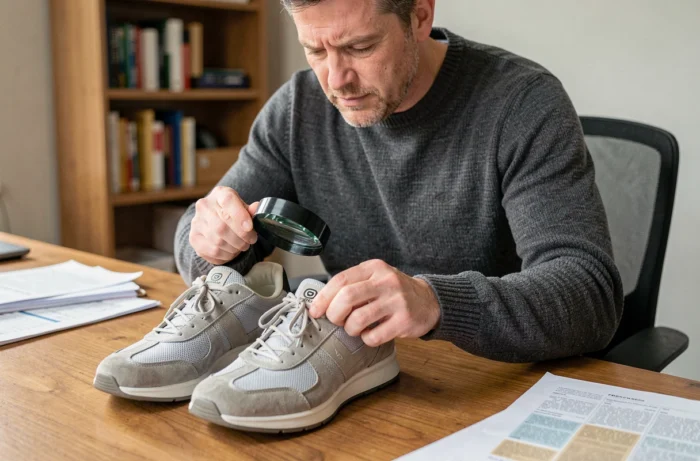
Comparison of authenticity indicators: original shoes versus counterfeits
The differences between an authentic pair and a copy fall into several categories. The table below summarizes the most discriminating checkpoints, those that remain reliable even when the counterfeit is well-made.
| Criterion | Authentic Shoe | Common Counterfeit |
|---|---|---|
| Seam | Regular, tight, with no visible threads | Irregular, loose threads, uneven stitches |
| General shape (profile) | Silhouette conforms to the official brand photos | Slightly distorted proportions (too wide toebox, flattened heel) |
| Odor | Subtle leather, textile, or rubber scent | Strong chemical odor (industrial glue, solvent) |
| Inner label and serial number | Clear font, number verifiable through the brand or an authentication app | Blurry font, irregular spacing, number absent from databases |
| Outsole | Sharp embossed logo, precise traction pattern | Flattened relief, simplified pattern or molding flaws |
| Box and packaging | Sturdy cardboard, clear printing, quality tissue paper | Thin cardboard, mismatched colors, lack of tissue paper |
The shape remains the most difficult criterion to reproduce for counterfeiters. Comparing the profile of the suspicious pair with official photos of the exact colorway (not another colorway of the same model) is the quickest and most reliable test.
Serial number and barcode: concrete verification
Each branded pair carries a serial number on the inner label. On Nike shoes, this number is also on the box and must match exactly. On Jordans, the style code allows you to find the model and colorway in public databases.
If the box number does not match the inner label number, the pair is a counterfeit in almost all cases. Some mobile authentication apps (like Authentif, available on iOS) allow you to scan these codes and cross-reference the results with reference databases.
Material quality and finishes: what touch reveals
Online photos are not always sufficient. Touch provides information that the eye does not capture on screen.
- Authentic leather shows natural irregularities (grain, slight texture variations). Leather that is too smooth and uniform on a pair that is supposed to be full-grain often indicates synthetic material.
- The insole of an original pair conforms to the foot with a uniform foam density. On a counterfeit, the foam is often too thin or too rigid, sometimes peeling at the edges.
- Laces from brands like Nike or New Balance have a tight weave and a slightly waxy texture. Counterfeits use flat, thinner laces with a loose weave.
The odor remains an underestimated indicator. An authentic new pair emits a subtle scent of materials (rubber, leather, textile). A strong and persistent chemical odor almost always betrays a counterfeit, as it comes from cheap glues and solvents used in unapproved factories.
Price, seller, and purchasing channel: warning signals upstream
Visual inspection comes too late if the purchasing channel itself is questionable. Price is the first filter.
A limited edition pair of sneakers displayed at a price significantly lower than that practiced on specialized platforms (StockX, GOAT, official stores) signals a high risk. Counterfeiters rely on the price gap to trigger an impulsive purchase.
- A seller without a verifiable sales history on a second-hand marketplace poses a higher risk than a specialized reseller with an authentication program (eBay Authenticity Guarantee, for example).
- Sites using dropshipping from third countries combine the risk of counterfeiting and the risk of customs blockage, as shipments outside the EU are now systematically subject to flat fees.
- Request detailed photos from multiple angles (inner label, outsole, seams, box) before buying from a private seller remains the most effective precaution on resale platforms.
Authentication programs of marketplaces
Several major platforms have implemented systematic authentication processes. The pair goes through a verification center before being shipped to the buyer. This service adds a few days’ delay but significantly reduces the risk of receiving a counterfeit.
These programs do not cover all models or brands. Checking, before purchase, whether the targeted model falls within the authentication scope of the platform avoids an unpleasant surprise.
The shoe counterfeiting market adapts quickly, and copies improve in quality every year. Systematically cross-checking visual inspection, serial number verification, and the reliability of the purchasing channel remains the strongest combination to protect a purchase, whether it is a pair of Jordans, New Balance sneakers, or a second-hand branded model.