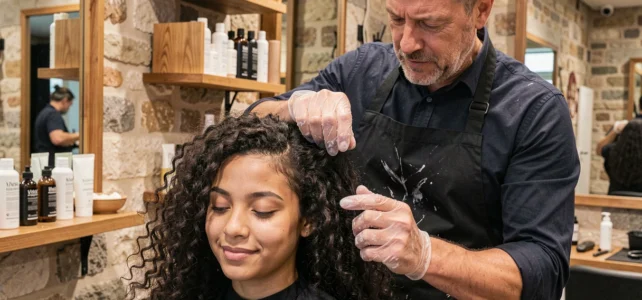
When you have curly hair and you push open the door of a traditional salon, the risk is well-known: a cut designed for straight hair, a blow-dry that flattens volume, and curls that take weeks to regain their shape. In Lyon, the Thomas Tuccinardi studio has built its reputation on an opposite promise: to work with the curl, not against it.
Dry cutting, balayage adapted to wavy to frizzy textures, targeted care protocols, the approach relies on precise technical gestures that deserve to be detailed.
Dry cutting on curly hair: why it changes the result
In most salons, the cut starts on wet hair. The problem is that the curl stretches under the weight of the water. The stylist cuts straight, the hair dries, and the length rises by several centimeters depending on the nature of the curl. You end up with a result that is shorter than expected, and above all, a shape that does not respect the natural fall.
Dry cutting allows you to see the curl in its true state, with its volume, movement, and areas of varying density. The stylist adapts each scissor cut to the spiral in front of them, not to a temporarily smoothed version by humidity.
At the Thomas Tuccinardi studio in Lyon, this technique forms the basis of every service. The diagnosis begins with an observation of the hair as it is worn daily, which avoids unpleasant surprises during drying.
Signature balayage on curls: techniques and limits to know
Classic balayage, applied strand by strand on straight hair stretched in aluminum foil, does not work the same way on curly hair. The strands do not fall evenly, and the light catches the curls in unpredictable ways. Poorly placed balayage creates areas of concentrated blonde on the outside of the curl and leaves the inside dark, resulting in a striped effect.
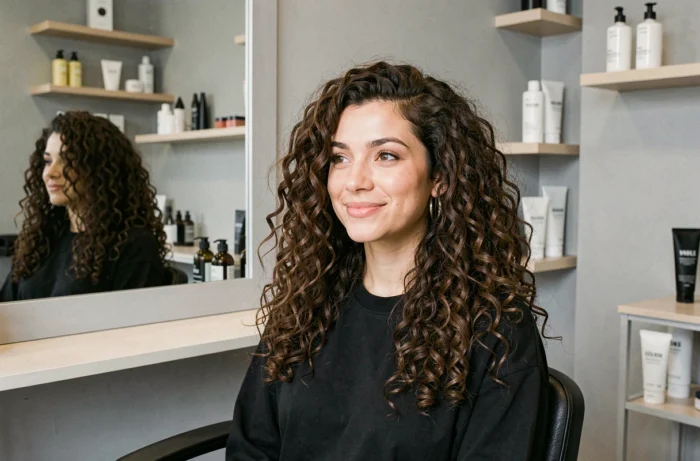
The signature balayage developed by Thomas Tuccinardi takes into account the position of each curl within the entire head of hair. Strands are selected curl by curl, not by flat section. The result gives a more diffused, blended light effect because the color follows the natural movement of the hair.
Feedback varies on this point: some very tight textures (type 4A and beyond) sometimes require several sessions to achieve a harmonious lightening without weakening the fiber. A prior consultation allows for an assessment of the hair’s condition and to establish a realistic coloring plan.
European regulations on hair dyes
The European regulation 2026/909, applicable from January 2027, restricts several dyes used in salons (HC Blue n°18, HC Red n°18, HC Yellow n°16, hydroxypropyl-p-phenylenediamine) with specific concentration limits. An allergy test 48 hours before each coloring becomes a reinforced requirement, both in salons and at home. For curls already weakened by natural dryness, this development pushes colorists to select even gentler formulas and to adhere to strict processing times.
Deep treatments for textured hair: what happens in the salon
Curly hair is structurally drier than straight hair. The helical shape prevents sebum from sliding down the hair shaft, leaving lengths and ends without natural protection. The care protocols offered in salons aim to compensate for this deficit with targeted contributions.
The brands referenced at Thomas Tuccinardi (Olaplex, Tokio Inkarami among others) meet distinct needs:
- Olaplex works on the reconstruction of disulfide bonds broken by chemical or thermal treatments, which strengthens the internal structure of the fiber
- Tokio Inkarami uses low molecular weight keratins that penetrate deeper into the hair cortex to restore elasticity
- Glossing treatments provide a layer of shine on the surface, useful for dull curls that lack light reflection
The choice of protocol depends on the initial diagnosis, not on a brand preference. A colored and porous curly hair will not receive the same treatment as a virgin curly hair that is simply dehydrated.
Curly hair consultation in Lyon: what this preliminary appointment is for
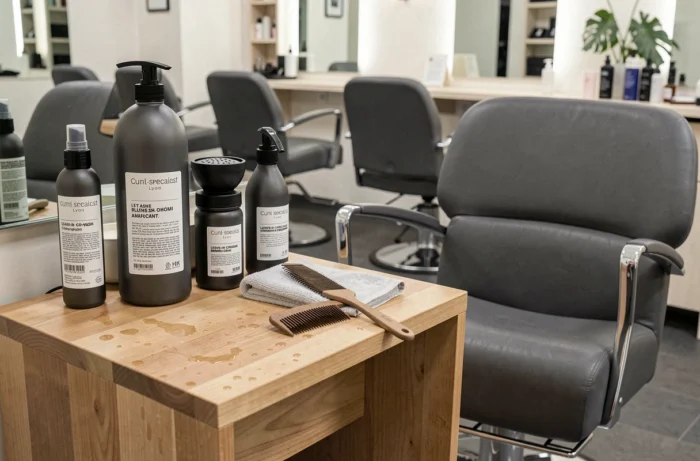
Before any technical service, the studio offers a dedicated consultation. This is not just a simple courtesy exchange: it assesses the hair’s porosity, the type of curl, the chemical history (past colorings, straightening, bleaching), and home styling habits.
This step allows for a realistic framework. A client who wants a very light balayage on a dark base with tight curls will not achieve the same result in one session as a client with loose waves on a chestnut base. The diagnosis avoids unrealistic promises and post-service disappointments.
It is also noted that the consultation addresses the hair care routine between two salon visits. A professional treatment applied every three months does not compensate for an inappropriate daily routine (harsh sulfate shampoo, maximum heat drying, brushing on dry hair). The stylist guides towards gestures and products compatible with the hair texture.
Coloring and minors: a regulatory constraint to remember
The European directive prohibits oxidation coloring and bleaching for those under 16 years old. For teenage girls with curly hair who want balayage, this restriction leads to alternatives without oxidants (glossing, plant-based coloring) or to waiting until the legal age. Serious salons apply this rule without exception.
Located in the 2nd arrondissement of Lyon, the Thomas Tuccinardi studio focuses its approach on an audience that is unfamiliar with their curls or has undergone unsuitable cuts for years. A stylist trained in curly textures can spot a problem with poorly cut layered overlaps in seconds that most general salons do not see.
For Lyonnaises and Lyonnais looking for a curly hair stylist, this level of technical understanding justifies the approach.