
Since 2012, every French minor must have their own identity document to travel. Registration on a parent’s passport is no longer valid at borders. Document preparation depends on three variables: the destination, the accompanying person, and the child’s nationality. Neglecting any of these can lead to boarding denial, even on a simple connecting flight.
Transit formalities and complete itinerary: the overlooked documentary trap
We regularly observe families preparing their documents for the final destination country without checking the requirements of transit countries. A non-compliant identity document can result in denial during a connection, even if the traveler does not leave the international zone.
The France Diplomatie sheet regarding Turkey confirms this: a non-compliant document can block a minor during a second flight in transit. Verification must cover each leg of the itinerary, including layovers.
Some countries now add digital formalities independent of the classic visa. For Mauritania, prior e-visa authorization must be presented before boarding or upon arrival, and then when leaving the territory with the entry stamp. These digital documents must be kept for the entire duration of the stay, including round trips.
We recommend systematically consulting the country sheets of France Diplomatie for each stopover, and finding more information on Concept Voyages to cross-check requirements by destination.

ID card or passport for minors: rules by geographical area
The distinction between national identity card and passport remains the basis of the documentary framework, but it includes subtleties that generic lists do not mention.
European Union, Schengen Area, and similar
A valid national identity card is sufficient for travel within the EU, the Schengen Area, as well as to Andorra, Monaco, or Switzerland. The DOM-TOM are also covered by the CNI.
Be cautious about the apparent validity of the card. For CNIs issued to adults between 2004 and 2013, France extended the validity period from ten to fifteen years without changing the date printed on the document. This rule does not apply to minors, but it often generates confusion within families comparing the dates on their own cards.
Some countries, even within the EU, apply stricter controls on the condition of the document. A damaged or hard-to-read title can pose problems at the border crossing.
Outside the European Union
A valid individual passport is mandatory. The required residual validity varies by country: some require validity covering the duration of the stay, while others impose a margin of several months beyond the expected return date.
Depending on the destination, a visa or electronic travel authorization may be added to the passport. Turkey, for example, recommends a travel authorization signed by the parent(s) for minors, in addition to the French documents.
Exit authorization from the territory: legal framework and special cases
The exit authorization from the territory (AST) applies to any French minor leaving the national territory without being accompanied by a holder of parental authority. This covers travel with a grandparent, an uncle, a school chaperone, or independent travel for teenagers.
The system relies on three cumulative documents:
- The Cerfa form 15646*01, signed by a holder of parental authority, without the obligation of signature legalization
- A photocopy of the identity document of the signer (CNI or passport)
- The identity document or passport of the minor, depending on the destination
When the child travels accompanied by one of their two parents, the AST is not required under French law. The accompanying parent does not have to prove the agreement of the other parent to leave the territory.
Additional requirements of the destination country
One point that the French framework does not cover: some countries impose their own rules for minors accompanied by only one parent. We observe that Turkey recommends a specific authorization signed by the absent parent, in addition to the French AST, including for school trips where a certificate from the head of the institution may be required.
These foreign requirements are not listed on the Cerfa form and are not systematically flagged during booking. Only a country-by-country check allows them to be identified.
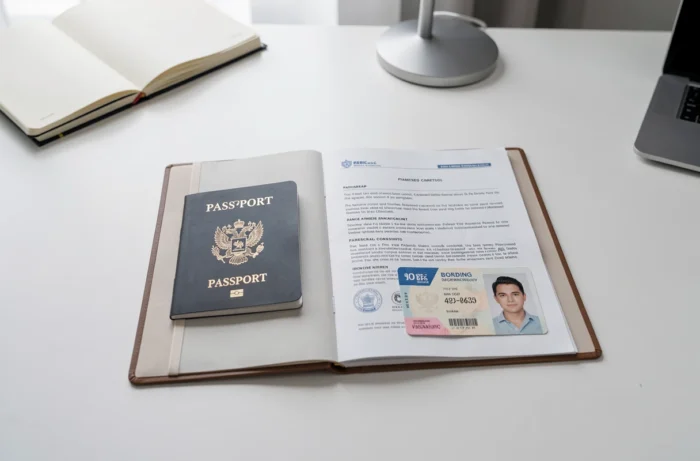
Prohibition and opposition to leaving the territory: practical distinctions
Two judicial mechanisms can block a minor’s departure, and they do not operate in the same way.
- The prohibition of leaving the territory (IST) is pronounced by the family court judge. It is recorded in the wanted persons file and prevents the issuance of a passport to the minor
- The opposition to leaving the territory (OST) is an emergency measure requested by a parent, valid for fifteen days, renewable once. It is reported to border police services
In practice, a parent who fears an unauthorized move of their child must act in advance. Once the minor has crossed out of the territory, remedies become more complex and fall under international conventions such as the Hague Convention on the Civil Aspects of International Child Abduction.
Border control does not automatically verify the agreement of both parents when the child travels with one of them. The IST or OST are the only mechanisms that trigger an active alert at exit points.
Thoroughness in document preparation is not limited to ticking off a list. Each stopover, each transit country may apply its own requirements, sometimes stricter than those of the final destination. Checking the complete itinerary, anticipating digital formalities, and distinguishing the French framework from local requirements remains the only reliable way to avoid a blockage on departure day.